A Summary for Australian Teachers
This article comes as a result of teachers asking us about the impact of puberty blockers and hormones on student academic achievement. The questions represent an interest in more information on this contentious issue from teachers who are expected to abide by gender affirming protocols.
Not every teacher will need this information. Hopefully you won’t. Unfortunately though, gender confusion is still on the rise. Teachers need to keep informed. Studies both supportive and against gender affirming care are included here where available.

Australian research on students with gender confusion is scarce. What there is however, is vital for teachers.
The main reason for this scarcity is that gender clinics around the country haven’t kept records of a child’s history or progression, or refuse to share them.
Another reason is that many clinics have not investigated a child’s family or environmental history. Their gender confusion is regarded as a medical condition instantly, rather than a psychological state caused by background events, social contagion or online misinformation. Below is the research that IS available.
Impact of puberty blockers (8-14 year olds)
These is no research available on how puberty blockers and hormones impact academic achievement in humans. Funding for this research is difficult due to probable negative findings on the major sponsors of most research – the pharmaceutical industry. There is also limited MRI research on how these drugs affect the brain or body of young patients. But …
In mammals and specific sheep research, it was found that puberty blockers impact the hippocampus, the part of the brain responsible for memory. Sheep that had been previously trained to easily navigate a maze could no longer find their way post puberty blocking.
While this is not on humans, this research has immense relevance for teachers and they should be aware of possible cognitive decline. The research is HERE. There has been no post-death studies on the brains of young people impacted by either puberty blockers or cross sex hormones.
The main contributor in this area is Professor John Whitehall who has made numerous submissions to parliament on the topic. An informative submission together with the referenced research studies can be found HERE.
Impact of cross-sex hormones (14-18 year olds)
- MRI studies on boys taking estrogen (boys transitioning to girls) found their brain shrinks 10x faster than ageing. This has immense relevance for teachers.
- While there are changes to muscle mass and sperm production, the only characteristic other students will notice is increased breast size.
- MRI studies on girls taking testosterone (girls transitioning to boys) found that grey matter zones increased. The impact of this hasn’t been studied.
- The girl’s voice will deepen and facial hair will begin to grow within 3-6 months of beginning hormone treatment. Scalp hair will decrease.
- If the female student has mental health issues before starting gender affirming testosterone therapy, they are more likely to show a (temporary) increase in anger proneness. HERE.
Impact of social transitioning (clothes, name, pronouns, haircut etc)
- Between 60-90% of students who socially transition proceed to puberty blockers, hormones and possible surgery) HERE.
- If left to naturally progress through adolescence without social transitioning, 85% of students will forget (desist) their gender confusion. HERE.
- Statistically, social transitioning is more likely to lead the student down the transgender pipeline of puberty blockers and hormones. It is therefore not regarded as a ‘benign’ practice. Teachers must me aware of this.
- There has been no Australian litigation against teachers allowing social transition leading to medicalisation, although this has begun in the USA.HERE and HERE.

Click the image to download.
Mental health of adolescents after treatment with puberty blockers and hormones
There has been no peer reviewed published studies of Australian adolescents in the years following gender affirming medical treatment. Any information is in the form of selected literature reviews obtained by pro-trans organisations.
The recent 2026 Finland peer reviewed study by Ruuska et al looked at adolescents over a 23 year period and found those experiencing medical gender reassignment (puberty blockers, hormones etc) showed significantly higher psychiatric morbidity. Summary opposite. A link to the study is HERE.

Family and environmental research
Internationally, there is very little research on the familial situation of children with gender dysphoria. One Australian study did look at the history and familial environment of the child. It looked at the kids, their backgrounds, families, and their introduction to a large children’s hospital in the Sydney suburb of Westmead. It also looked at where they got their pre-hospital information.
Written by six authors with impeccable credentials, The Westmead Study provides a great insight into who exactly these kids are.
It is strongly relevant for teachers.
As this is only one study, it can’t be taken as fully representative without comparing it to others. It is examined together with relevant sections of other studies including the trans-positive 2017 Australian Trans pathway study and the 2020 report. The Westmead statistics below are highlighted in bold.
The summary waves obvious red flags to medical practitioners, educators and politicians about the dangers of gender affirming treatment. The studies discuss the multiple problems most of these children have that contributed to a life needing radical change – any change – at any cost.
While research is very scarce on an individual’s mental health post transition, Transition does not address underlying mental health conditions. It may however, improve body image and self esteem in the short term. Most studies only measure subjective self-analysis within 12 months of transition.
These important points, have been unaddressed by Australian and international gender clinics in the rush to drive both children and parents down the transgender drug and surgery pipeline.
It’s been ignored also by mainstream media and education departments in Australia because it raises questions of gender ideology.

1: Who did the Westmead doctors study?
The Westmead study was on 79 gender dysphoric children presenting at the hospital aged between 8.4 – 15.9 years old. The Westmead statistics are below in bold.
- 33 biological males (42% of the cohort) | 46 biological females (58% of the cohort).
- The Australian Trans Pathway Study of 859 trans young people found that only 25.6% of their cohort was male while 74.4% were female.
2. Patient traits leading to gender confusion
- 2.5% had an eating disorder
- The Trans Pathway Study found 23% had an eating disorder
- The Jessica Kerr et al study found that 23.9% had an eating disorder
- 41.8% had thoughts about suicide
- Most other studies state that there is not enough evidence that trans-inclined youth are more likely to think about suicide than any other adolescent. However, between 40-50% is the average figures stated in most international studies.
- 10% had attempted suicide
- The Trans Pathway Study found 48.1% had attempted suicide. It is possible that the thought and the action of suicide have been linked together here.
- The Trevor Project found 6% had attempted suicide
- 49.4% had self-harmed.
- The Trans Pathway Study found 79.7% had self-harmed
- The Jadva et al Study found 65% had self-harmed
- 63% had anxiety or depression
- The Trans Pathway Study found 72.2%
- The Murdoch Children’s Research Institute Study found 75% of all adolescents experienced anxiety and depression
- 35.4% had a behavioural disorder or ADHD
- The Goetz et al Study makes the same conclusion as most studies. “The existing data … suggest a significantly increased prevalence of ADHD among trans identifying persons.”
- The Kaiser Permente Study found gender questioning youth have an average 50% ADHD compared to a youth population average of 10.5%
- 13.9% had autism
- The Trans Pathways Study found 22.5% had autism
- The Michelle Tollit Study found 45% had autism
- The Thrower et al Study found between 6-24% (general population = 1.85%)
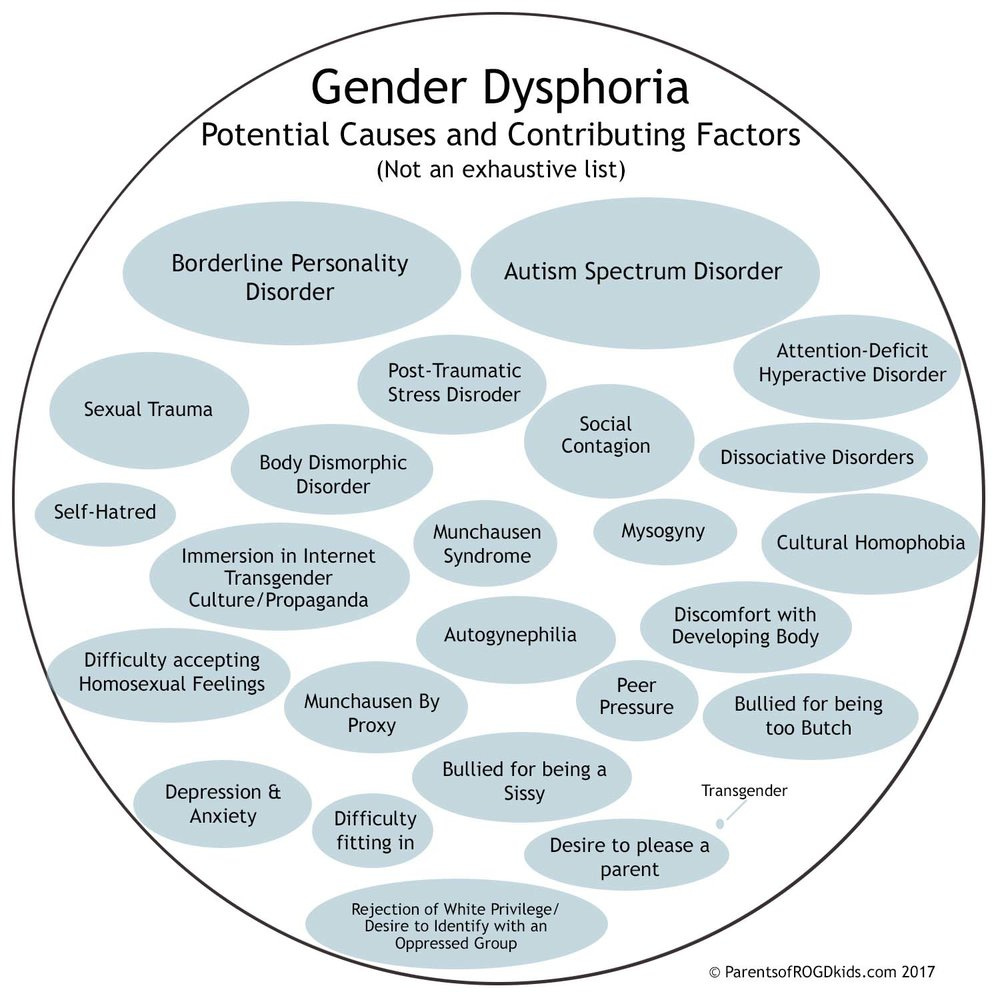
3. Adverse Childhood Experiences
- Only 2.5% reported having no adverse childhood experiences
- 19% had experienced child sexual abuse
- The Trans Pathway study found 32%
- The Biedermann Study found 21%
- The Thoma and Rezeppa Study found 19% had experienced child sexual abuse.
- 63.3% had a parent or parents with mental illness
- At time of writing, there is no available research on this from international studies.
- 59.5% had lost important figures through separation
- The Regers and Swihart study found that 66% of trans identified boys had separated parents
- The few other studies available state 22-35%
- 54.4% had been bullied
- The Trans Pathway study found 74%
- 39.2% had experiences of childhood physical abuse
- The trans pathway research found 49.9% had experienced physical abuse
- The Thoma and Rezeppa Study found 39% had experienced child physical abuse.
- Child Protection Authorities had been involved with over half of the families in the Westmead Study.
- No data available from other studies.
Summary
Most of these children had family profiles which produced stress. The telling statistic is that 63.3% of the kids had a parent or parents with a mental illness. That such a large percent had experienced childhood sexual abuse is also pivotal.
With such fragmented backgrounds, no wonder these children wanted to be someone else. The transgender pipeline is a way out of an existing identity, an out that’s easy, cheap, socially cool and parent endorsed.
The questions for educators are …
Were these familial causes of stress well investigated before gender affirming treatment was even discussed?
Were these causes addressed?
Would the child still be experiencing maltreatment or stress at home?
How is the parent’s mental illness being treated?
What does the Government Child Protection Report state?
4. Living situation of the kids
Living with …
- Both mother and father 38.0% (national average = 84%)
- Mother alone 26.6% (national average = 11.3%)
- Mother with new partner 17.7% (national average = 9%)
- Father with new partner 12.7% (national average = 9%)
- Foster care 3.8%
- Living with father alone 1.3%
The Trans Pathway Study, strangely, didn’t ask this question.
It’s clear that while the proportion of intact two parent families are very under-represented compared to the national average, the number of children living with mum only (26.6%) is well over-represented.
Nearly 50% of the kids come from a family without dad about or where dad has minor influence. This is not representative of society in general where 20% of families are like this.
5. What did families expect at the Westmead Clinic?
- 77.2% of children and 70.9% of parents said that they were attending the clinic because they were seeking a referral for puberty-blockers.
- 88.6% of parents but only 41.8% of children were interested in a more holistic approach that included psychological support for the child and family.
- In 11.5% of cases, the attending parent (usually the mother) reported that the child’s other parent was—or would be – strongly opposed to the child attending the Gender Clinic, and any interventions.
6. Important quotes from the study.
1.
“Our results suggest the need to bring into play a biopsychosocial, trauma-informed model of mental health care for children presenting with gender dysphoria. Ongoing therapeutic work needs to address unresolved trauma and loss, the maintenance of subjective well-being, and the development of the self.”
2.
“…clinicians rated almost three-quarters of the families (73.4%) as presenting in a state of stress due to family conflict or perturbations to family function in the context of other ACEs (adverse childhood experiences). DASS scores confirmed the high levels of depression, anxiety, and stress felt by the children and their mothers.”
3.
”Despite the clinicians’ perspective that families presenting to the Gender Service were typically in substantial distress and struggled in many domains of family function—as evidenced by their stories of conflict, relationship breakdown, parental mental illness, and maltreatment (see Table 3) —the families themselves did not perceive themselves in this way (see Figure 2 and Table 6). The families did not seem to understand the possible connections between the family story — sometimes across generations — and the child’s clinical presentation with distress, anxiety, depression, and gender dysphoria.
“Not surprisingly, families tended to medicalize the child’s distress, attributing it solely to gender dysphoria as an isolated phenomenon, with the consequence that the family identified the medical pathway as providing the only potential way forward. The motivation to engage in individual or family work to explore the broad range of difficulties and psychological, family, or loss/trauma issues contributing to the clinical picture was generally low”.
4.
”Very often, we the clinicians felt that our efforts to work from a biopsychosocial perspective, along with our therapeutic efforts to discuss different aspects of the medical situation, fell on deaf ears. Lost were our efforts to highlight the many different pathways in which gender variation could be expressed, to explain potential adverse effects of medical treatment, to explore issues pertaining to future fertility and child rearing, and to highlight the importance of ongoing psychotherapy”.
7. Social media and the trans-contagion
35.4% of the Westmead cohort reported that seeing information on the internet or via a documentary had contributed to their feeling of, “This is me”.
In the Trans pathway Study, 74% of the cohort sought help from social media.
Another 7.6% reported using the internet to gain more information—often together with a parent—after they had disclosed their feelings of dysphoria.
International sources state key resources include websites like TransHub, LGBTQIA+ services like Headspace and Minus18, specialist gender clinics at hospitals, and school counsellors. Parents also access information via peer support networks like Parents of Gender Diverse Children.
It is notable that both parents and children receive information mainly from specialist gender sites and services, not general practitioners or non-specific psychological services. These specialist sites and services are pro-trans in their approach.
For Teachers, Principals or Parents needing help or advice on this issue, please contact us via the form below.